


Religious Education
Religious Education is a vital part of our curriculum and plays an important role in bringing our Christian vision to life. Through high-quality RE, children develop the knowledge, curiosity and confidence to explore faith, ask meaningful questions and engage respectfully with beliefs and experiences that may be similar to or different from their own.
We follow the Southwark Diocesan Board of Education Primary RE Syllabus. Christianity is studied in depth, alongside a broad range of religions and non-religious worldviews. Children learn that there is rich diversity within Christianity and within every religious tradition; faith is not presented as a single set of identical beliefs or practices.
Our curriculum develops three interconnected types of knowledge:
- Substantive knowledge – what pupils know about religions, beliefs, practices and important concepts;
- Disciplinary knowledge – how pupils investigate religion and worldviews using the methods of theology, philosophy and the human and social sciences;
- Personal knowledge – how pupils recognise, reflect upon and communicate their own developing ideas and perspectives.
Learning is explored through the syllabus’s three golden threads:
- Believing – examining theological questions about God, belief and sources of authority;
- Thinking – exploring philosophical questions about meaning, truth, morality and what it means to be human;
- Living – investigating how beliefs are expressed in diverse ways through people’s lives and communities.
Each unit is guided by an enquiry question and follows a purposeful journey of engaging, enquiring, exploring, evaluating and expressing. Children learn to interpret sources, consider evidence, make connections, explain different perspectives and agree or disagree respectfully.
Building Knowledge Over Time
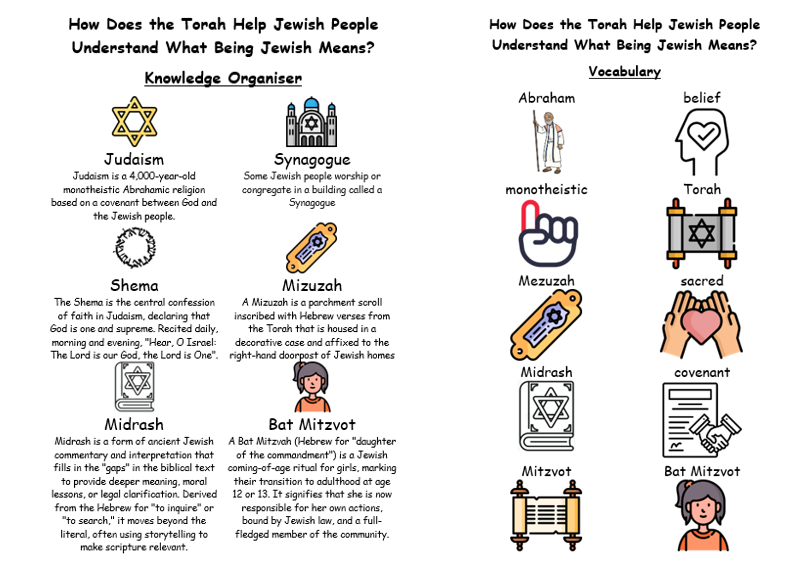
Our RE curriculum is carefully sequenced so that important concepts are revisited and deepened as children move through the school. Knowledge organisers identify the essential knowledge pupils should learn and remember within each unit. Key subject-specific vocabulary is also mapped progressively, enabling children to speak and write about religion with increasing accuracy, confidence and sensitivity.
Regular retrieval, discussion and carefully designed tasks help teachers identify what children know and understand. Pupils have opportunities to demonstrate their learning through dialogue, reflection, extended writing, creative responses and the interpretation of texts, artefacts and other sources of evidence.
Learning is enriched through religious artefacts, art, music, visitors and visits to places of worship. These meaningful encounters help children understand religion as something that is lived, experienced and expressed in varied ways.
Through RE, pupils develop religious literacy, challenge misconceptions and consider questions of dignity, equality and justice. It helps them understand their own place in the world and prepares them to participate positively in a diverse society as respectful, compassionate and thoughtful shining lights.
Cultural Studies
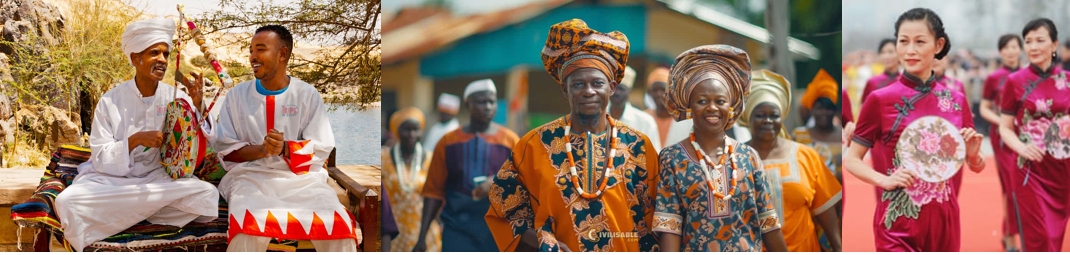
Cultural Studies is a distinctive and important part of our curriculum at St John Baptist. It reflects the rich cultural heritage of our school community and ensures that children encounter a world that is broader, more diverse and more interconnected than any single subject can fully reveal.
Each year group undertakes focused studies of countries and cultures that connect meaningfully with its wider curriculum. These include places as varied as Ghana, Poland, Zimbabwe, Mauritius, India, Iraq, Vietnam, Sierra Leone, Brazil and Trinidad and Tobago. Connections are deliberately made with children’s learning in history, geography, religious education, reading and Understanding the World.
Children explore each culture through several connected dimensions:
- location, landscape and climate;
- significant people, events and historical developments;
- traditional and contemporary stories;
- festivals and celebrations;
- art, craft and design;
- music, instruments and dance.
This approach allows children to build a rich and rounded understanding of a place rather than encountering cultures through isolated festivals, famous individuals or stereotypes. Pupils explore how geography, history, migration, belief and creativity have influenced people’s lives, while recognising that every country contains many identities, traditions and experiences.
Cultural Studies also creates opportunities for children, families and staff to share knowledge connected with their own heritage. Children see their identities reflected with dignity in the curriculum while also developing curiosity about lives and experiences beyond their own.
The studies are enriched through stories, music, art, dance, artefacts, performances and links with the wider curriculum. Children do not simply learn facts about a country: they encounter its voices, creativity and cultural contributions.
Through Cultural Studies, we seek to:
- strengthen every child’s sense of identity and belonging;
- celebrate the diversity represented within our school;
- broaden children’s knowledge of the world;
- challenge stereotypes and incomplete narratives;
- recognise the impact of migration, exchange and shared history;
- develop respect, empathy and genuine interest in others.
Cultural Studies embodies our belief that every person and community has a story worth knowing. It enables children to see diversity as a source of knowledge and strength and helps them become confident, respectful and culturally aware shining lights.